

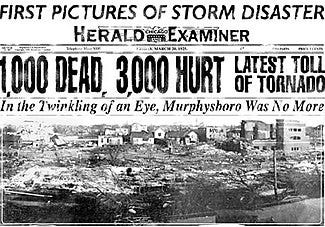
Today (3/18) is the anniversary of the great Tri-State Tornado of 1925. One Hundred One years later, it stands as the deadliest tornado in U.S. history. The newspaper headline above shows 1,000 fatalities. Further studies over the years put the estimated death toll at 695.
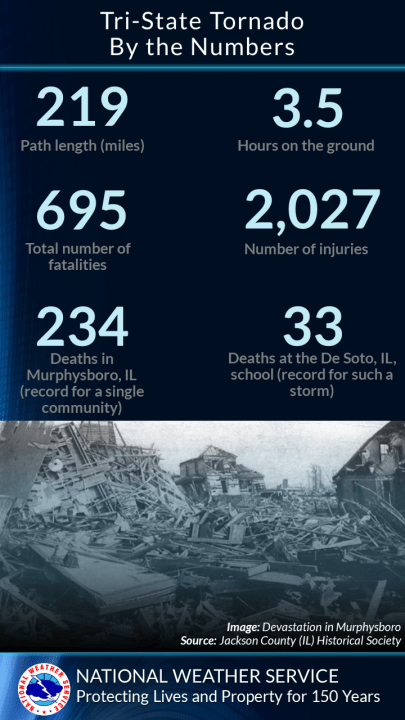
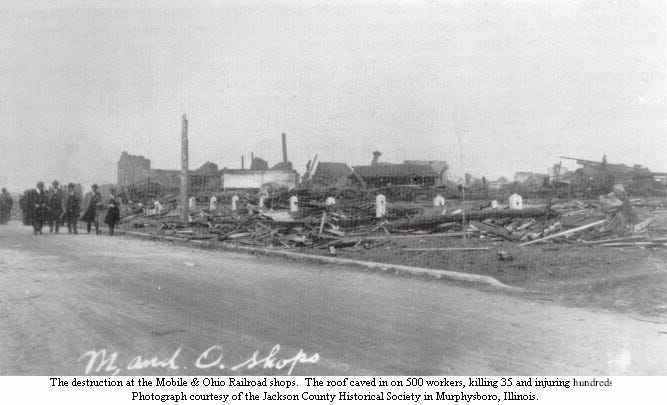
The tornado appears to have been on the ground continuously for 219 miles, crossing the Mississippi and Wabash Rivers from Missouri, through Illinois and into Indiana. In Murphysburo, Illinois 1200 homes were destroyed within an area that was 2 1/2 miles long and 1 mile wide.
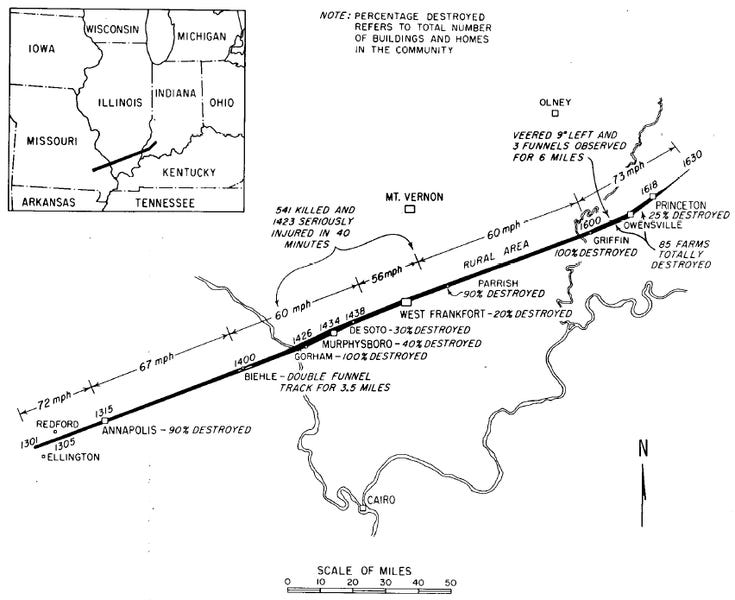
The tornado began shortly before 1 pm near Ellington MO. There were 11 fatalities in Missouri.
The devastation mounted in southern Illinois, as the entire town of Gorham was demolished around 2:30 p.m. In Gorham 34 people lost their lives. During the next 40 minutes, 541 people were killed and 1,423 were seriously injured as the tornado tore a path of destruction nearly one mile wide through the Illinois towns of Murphysboro, De Soto, Hurst-Bush, and West Frankfort. In eastern Franklin County, 22 people died as the town of Parrish was virtually wiped off the map. The tornado proceeded unabated across rural farmland of Hamilton and White Counties, where the death toll reached 65.
There were many people who did not recognize the storm as a tornado. It was unusually wide and picked up a lot of dirt. People thought a dust storm was approaching. Others went outside or to west-facing windows to watch the storm. Many homes and buildings did not have basements or an area underground where they might have survived.
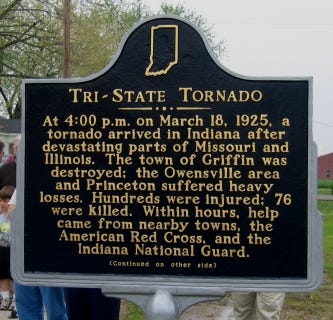
After taking the lives of more than 600 people in Illinois, the storm surged across the Wabash River, demolishing the entire community of Griffin, Indiana. Next in line were the rural areas just northwest of Owensville, where about 85 farms were devastated. As the storm ripped across Princeton, about half the town was destroyed, with damage here estimated at $1.8 million (in 1925 dollars). Fortunately, the twister dissipated about ten miles northeast of Princeton, sparing the community of Petersburg in Pike County.
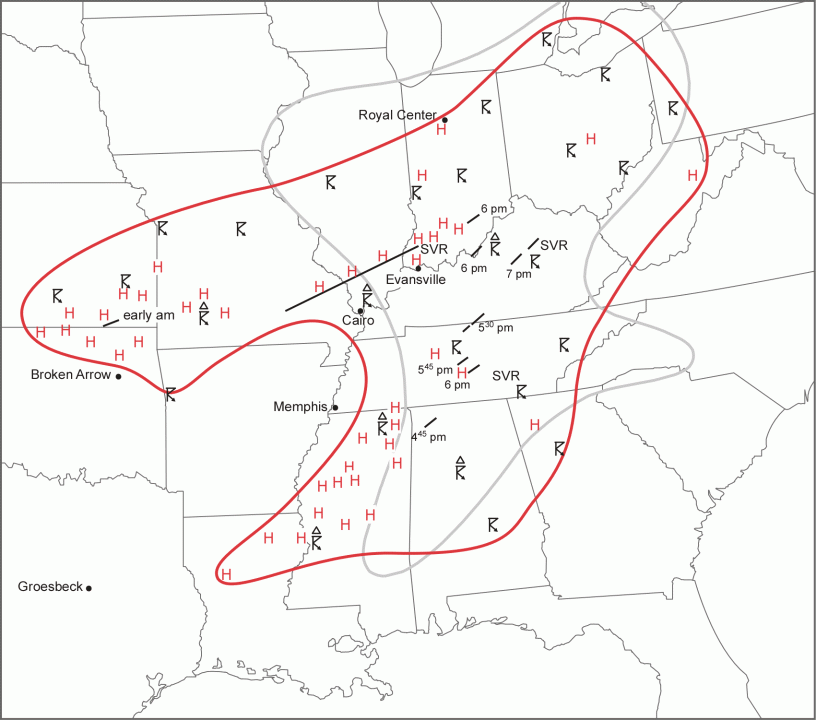
There were at least 12 tornadoes over a 7-hour period on 3/18/25. Severe weather also included thunderstorm straight-line wind damage and hail up to softball-size near Lexington, Kentucky.
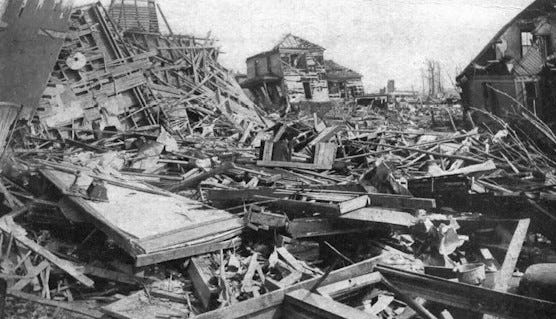
Many buildings were built of wood or brick and were no match for the F5 level winds, which could have been as high as 200 mph. Damage estimates are roughly 2.5 billion in 2026 dollars.
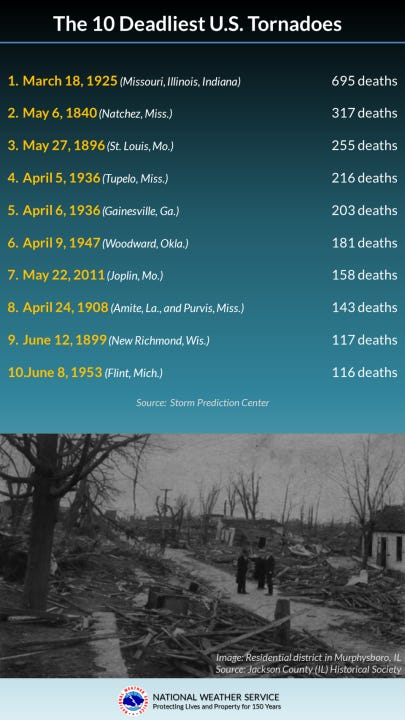
Here’s a list of the deadliest tornadoes in U.S. history. The Tri-State Tornado resulted in more than twice as many fatalities as the Natchez Tornado in 2nd place. Note that the Flint tornado of June 8, 1953 makes the top ten. Here’s more statistics.
Also, check out: Personal account of the storm…”I was four years old at the time…it just kept gettin’ darker and darker, it was almost as black as night when we finally went to the cellar.” “the air was filled with 10,000 things. Boards, poles, cans, garments, stoves, whole sides of the little frame houses, in some cases the houses themselves, were picked up and smashed to earth.” The meteorology of the Tri-State Tornado. Links and resources.
About 20 years ago, I spent an afternoon researching this tornado at a library in southern Illinois.
“Startling Statistics, ” provides the following information about the tornado:
* Began at 1:01 p.m. with touch down near Ellington, Missouri
* Dissipated near Petersburg, Indiana at 4:30 p.m.
* There were 3.5 hours of continuous devastation.
* Path length was 219 miles.
* Average path width has been calculated from .75 mile up to one mile, a record width at the time.
* Rotating winds of up to 200-250 mph have been calculated.
* Average forward speed of the tornado has been calculated to have been 62 mph.
* At least 695 people died.
* At least 2,027 people were injured.
* 15, 000 homes were destroyed.
The low pressure center on 3/18/25 moved along a similar path relatively close to the path of the tornado. This was similar to the Kalamazoo tornado. On that day (5/13/80), Grand Rapids never got into the warm sector. Temperatures were in the 50s in Grand Rapids and 70s along and south of I-94.
One thing is for certain—a similar storm like it will happen again. The only question is: when and where? We would hope that since most people know tornado safety and because of today’s better watches and warnings that the death toll might be significantly lower.
Scary story…my only memory re tornado in GRR: the Standale Tornado … the sky was green